Need your fire stopping checked? Veritas inspects it in existing buildings and during construction. Fire Compartmentation Survey
What is fire stopping?
Approved Document B describes fire stopping as a seal that closes an imperfection of fit or design tolerance between elements or components, to restrict the passage of fire and smoke. In practice it is the material around every service that passes through a compartment wall or floor, and in joints where walls meet floors and soffits. It is one part of Fire Compartmentation.
What products are used for fire stopping?
| Product | Typical use |
|---|---|
| Intumescent sealant | Small gaps around pipes and cables, and linear joints. |
| Coated fire batt | Larger openings with several services, such as cable trays. |
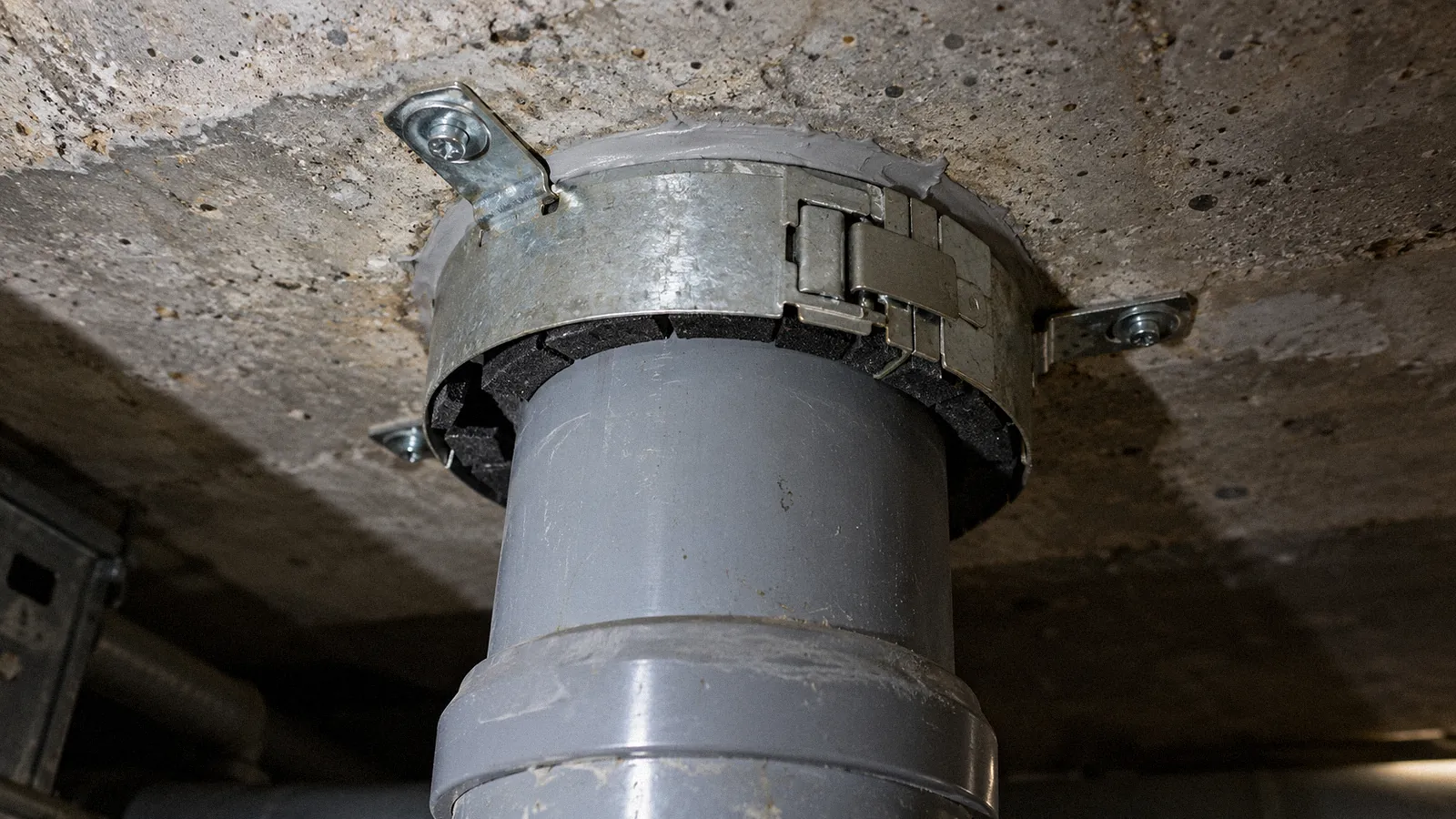
| Pipe collars and wraps | Plastic pipes, which melt in a fire and leave an open hole unless the collar closes it. |
| Fire-rated mortar | Openings in masonry and concrete floors. |
| Fire pillows | Openings where services are changed often. |
Where is fire stopping needed?
- Wherever a pipe, cable, duct or tray passes through a compartment wall or floor
- At the head of compartment walls, where they meet the slab above
- At junctions between compartment walls, floors and external walls
- Around the frames of fire doors and fire-rated glazing, where the installation details require it
What do the regulations require?
Requirement B3 of the Building Regulations requires buildings to resist internal fire spread, and Approved Document B gives the guidance: openings for services through compartment walls and floors should be kept as few and small as possible and fire-stopped. Fire stopping should be a system with test evidence for that service and substrate (BS EN 1366-3 for penetrations, BS EN 1366-4 for linear joints, classified to BS EN 13501-2), or a solution Approved Document B accepts. A seal with no evidence of performance cannot be confirmed as compliant. In buildings in use, the Regulatory Reform (Fire Safety) Order 2005 requires fire stopping to be maintained.
Is there certification for fire stopping?
Yes, for installers. Third-party certification schemes such as FIRAS and IFC Certification assess fire stopping contractors and audit their work. Certification of the installer does not replace independent inspection of what was installed.
What does intumescent mean?
An intumescent material swells when heated. In fire stopping, it expands to fill the gap left as plastic pipes and cable sheaths burn away, keeping the seal closed. The same principle is used in Fire Door Seals.
How is fire stopping inspected?
Each penetration is located and compared with the manufacturer installation detail and its test evidence, and defects are photographed; where the visual check is not enough, a small section is cut out to confirm the product and depth. Veritas does this as a fire stopping survey in existing buildings and during construction.